
Mycelium
Generative urban massing for Rhino 8 and Grasshopper
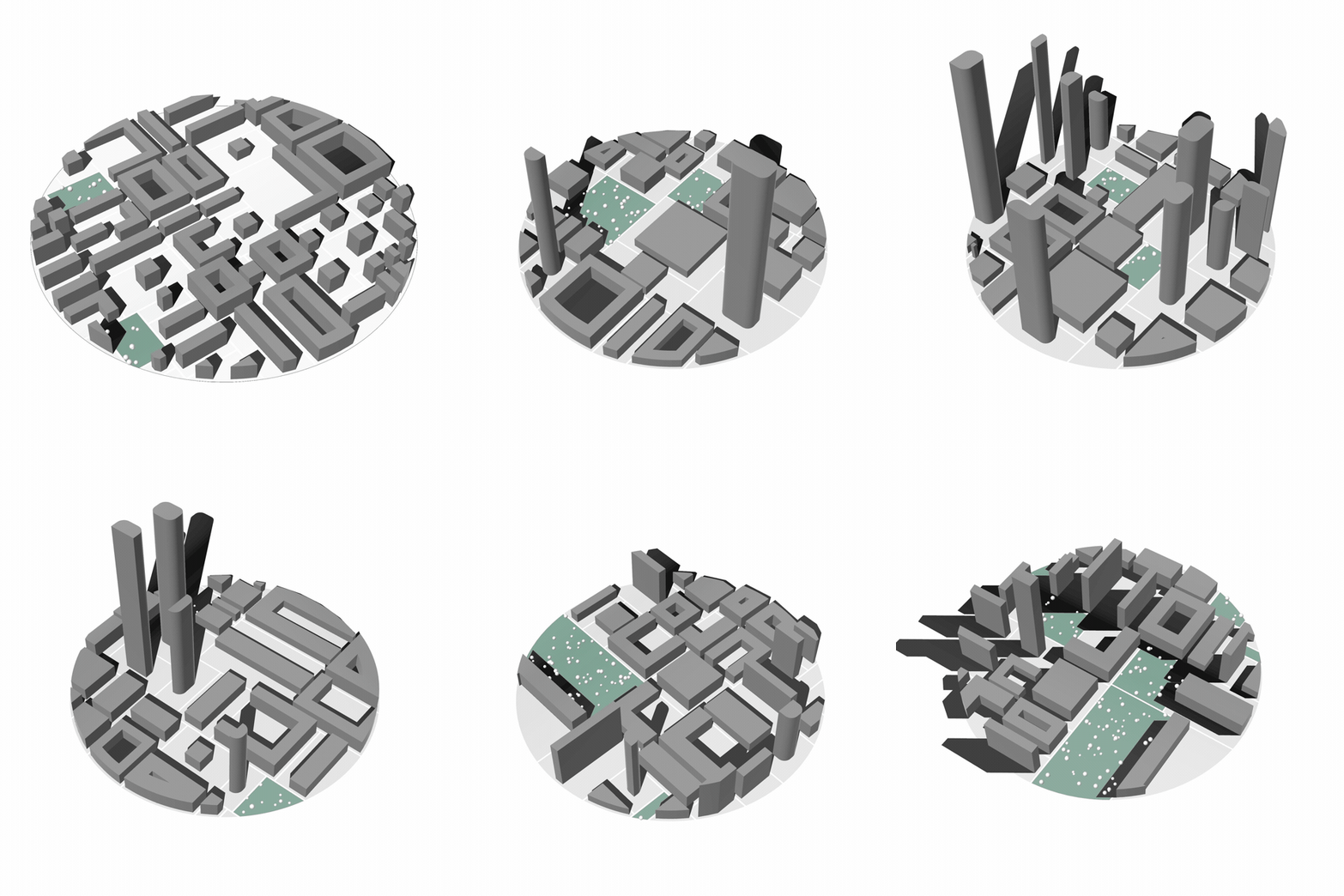
Free and open source under Apache 2.0. Installs through the Rhino Package Manager.
What It Does
 What It Does
Mycelium takes a closed parcel boundary curve and generates complete urban massing alternatives. Every output is driven by a random seed, so alternatives are fully reproducible — the same seed and the same parameters always give you the same city.
-
Subdivision
Recursive binary space partitioning splits the parcel into building blocks separated by streets. Choose between irregular, orthogonal, diagonal, and radial–concentric street-network families — each with several sub-options.
-
Typologies
Each block receives a randomly selected building type from the configurations you allow: courtyard (perimeter block), linear bar, point block, L-shape, U-shape, or tall tower.
-
Open Space
A chosen number of blocks become parks, populated with procedural trees. Courtyards can receive trees too, and terrain is generated from OpenSimplex noise.
-
Metrics & Provenance
Development metrics, environmental morphology indicators (
lambda_p,lambda_f, height statistics), and a versioned JSON case manifest with a deterministic SHA-256 case ID for every alternative.
Get Started
 Get Started
Install from the Rhino 8 Package Manager, then open a template — the Mycelium Templates component pulls working example definitions matching your installed version, so the first thing you see is a graph that already runs.
Authors
 Authors
Dr. İlker Karadağ
Associate Professor of Architecture
Sakarya University
@karadagi
Dr. Patrick Kastner
Assistant Professor, School of Architecture
Georgia Institute of Technology
@kastnerp
Developed at the Sustainable Urban Systems Lab, Georgia Tech School of Architecture.
Citation
 Citation
If you use Mycelium in research, please cite the software release:

@software{karadag_mycelium,
  author  = {Karadag, Ilker and Kastner, Patrick},
  title   = {{Mycelium: Procedural Urban Morphology Generation for Rhino and Grasshopper}},
  year    = {2026},
  version = {0.1.0.4},
  license = {Apache-2.0},
  url     = {https://github.com/MyceliumGH-Dev/Mycelium}
}
Releases from 0.1.0.4 onward are archived on Zenodo with a versioned DOI. GitHub also generates an up-to-date APA or BibTeX string from the repository's CITATION.cff — open the repo and use Cite this repository in the right-hand sidebar.